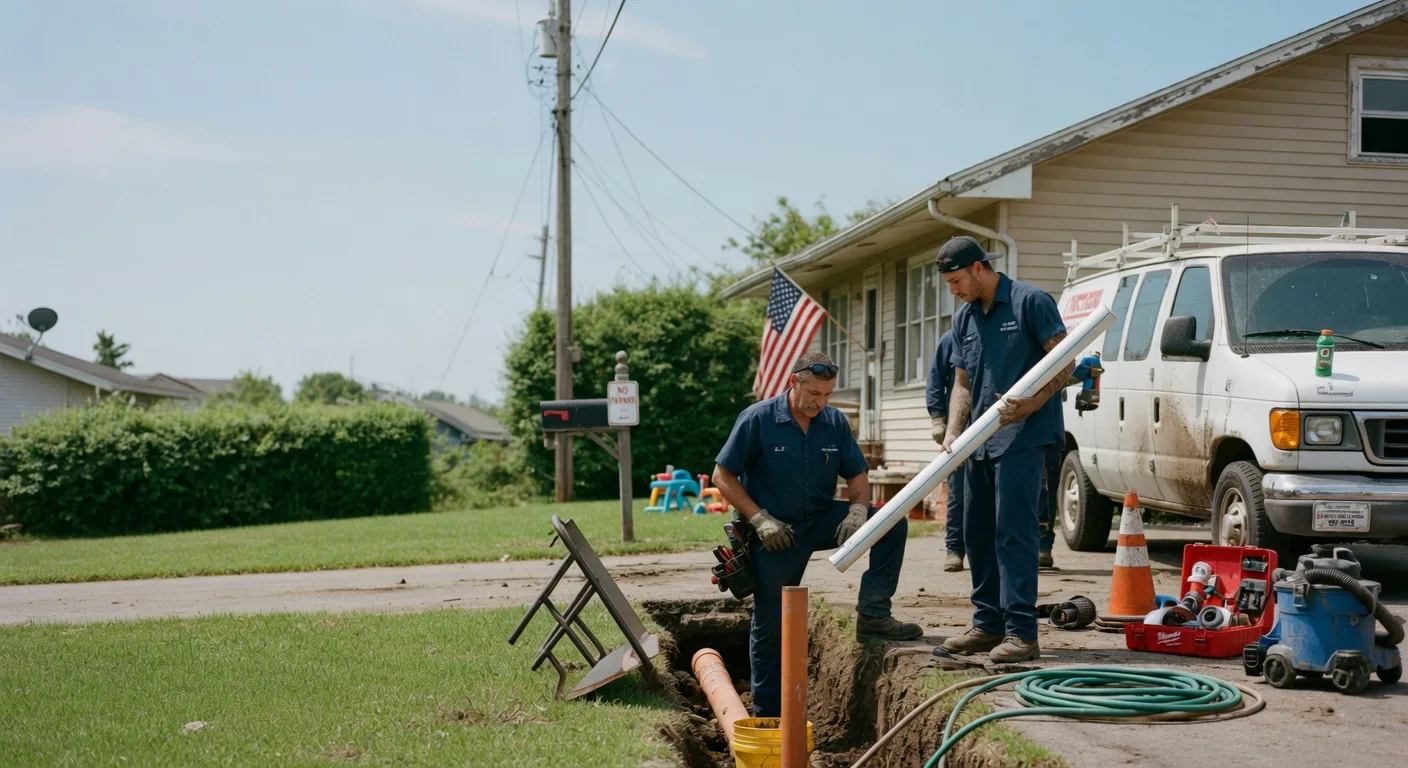
What does grease actually do to a drain pipe?
Grease leaves the sink as a liquid, and the pipe is where it stops being one. Warm fat cools on contact with the cold pipe wall and hardens into a waxy layer. That layer is slightly sticky, so it grabs coffee grounds, food scraps, and lint, and each meal adds another coat. Over weeks the opening shrinks like an artery, and water that used to flow freely starts to drain slowly and gurgle. Hot water does not fix this; it only carries the grease farther down the line, where it cools and sets again, sometimes in the main. That is why a kitchen sink that slows while every other fixture drains normally is nearly always grease in the branch line close to the trap. A cable machine cuts a channel through the buildup and often restores flow, but the coating stays on the pipe wall and narrows again within weeks. Hydro jetting sends high-pressure water around the whole interior and strips the grease off the pipe wall, which is why it is the usual answer for repeat kitchen clogs. Wiping pans with a paper towel and putting fat in the trash prevents most of it. Expert Plumbers Co connects homeowners with an independent local plumber who can tell whether a cable or a jetter fits the line. Access and the amount of buildup affect the job.
The place where most people go wrong is the hot water habit. Running hot water for a few seconds after washing dishes does not carry grease to the sewer, it only moves it down the line a few feet, where it cools and sets. A much better routine is to scrape plates into the trash, wipe greasy pans with a paper towel, and keep a jar for cooking oil that can go in the garbage once it is full. Dish soap makes grease look like it has dissolved, but it only breaks it into smaller droplets that still stick further along. Garbage disposals do not solve this either, since they chop food without removing the fat. In restaurants and busy households, a grease trap or interceptor may be present, and it needs regular emptying. If the sink has slowed repeatedly, mention that to the plumber, since a pattern points to a coating that needs scouring rather than another quick clear.
What is the difference between a septic system and a city sewer line for drain problems?
The two systems fail in different places, so the first job is knowing which one your home has. A city sewer line carries wastewater from your house to a municipal main, so trouble is usually confined to the pipe: roots at a clay joint, a bellied section, scale in old cast iron, or a blockage in the lateral. Every drain in the house backing up at once typically means the private line or the connection at the street. A septic system adds a buried tank and a drain field. Solids settle in the tank, and liquid flows out through perforated pipe into the soil. Slow drains or backups can mean a tank that is full and overdue for pumping, a clogged outlet filter or baffle, a failing drain field that can no longer absorb water, or a blockage in the short line between the house and the tank. Soggy ground or a strong odor over the tank area points away from the house plumbing. A cable machine or hydro jetting can clear the house line on either system, but jetting into a septic line needs care about where the water and debris end up. Property paperwork, a cleanout location, or the water utility can tell you which system you have. Expert Plumbers Co connects homeowners with an independent local plumber who works on that type of system.
Homeowners often assume a septic problem and a city sewer problem look the same from the bathroom, but there are a few quick clues. On city sewer, a backup after heavy use is usually the private line or the lateral at the street, and neighbors on the same main may have had the same trouble. On septic, the problem tends to build slowly: drains slow down across the house, the toilet flushes weakly, and a patch of lawn stays wet or unusually green. A common mistake is pouring additives into a septic tank hoping to fix a failing drain field. They do not repair soil that has stopped absorbing water. When you call, tell the plumber how old the system is, when the tank was last opened, and where the cleanout or lid sits. In older homes the tank may be buried deeper than expected and need to be located first, which adds time before any repair starts.
Sewage has backed up into my basement. What do I do right now?
Stop running water in the house now. That means toilets, sinks, showers, the washing machine and the dishwasher. Every gallon you send down the line has nowhere to go but out through the lowest opening, which is your basement floor drain.
Stay out of the water. Keep children and pets away. If you must go in, wear boots and gloves, and do not touch outlets or appliances while standing in it. Do not pour chemical cleaners down any drain.
One safe check: look at whether other drains upstairs are gurgling or slow. If they are, the main sewer lateral is blocked or failing. Typical causes are root intrusion at a clay joint, grease build-up on the pipe wall, a bellied line holding water, or a collapsed section. A single slow fixture is a branch line problem. A basement backing up with the whole house affected is a main line problem, and it needs different equipment.
This is Emergency Drain Cleaning, and it is not a homeowner job. A cable machine at the cleanout can clear a soft blockage. Roots and grease usually need hydro jetting, and a camera inspection shows why the line stopped.
Cost depends on cleanout access, what is found in the pipe, how much has to be removed or repaired, and any permit requirement. Expert Plumbers Co is a referral service. Call (380) 262-9173 and we will refer you to a plumber serving Hanlontown, IA.
Once the water is stopped, take photos of the water line and the affected items before anything is moved, and write down the time you first noticed it. If the backup is sewage, do not use a wet vacuum or a household fan on it, and do not start throwing out porous items until the plumber has opened the line. Tell the plumber what ran just before the backup, such as a load of laundry or a long shower, and whether the floor drain or a basement toilet was the first place it showed. In an older home with a clay or cast iron lateral, the cause is often roots or a collapsed section. In a newer home it is more often a belly, a joint that was set poorly, or a heavy wipe or grease blockage. After the line is cleared, the floor and walls still need proper cleaning and drying, and that is separate from the plumbing repair.
What should I clear out or get ready before the plumber arrives to unclog my drain?
A little preparation saves time at the door and often means a cleaner, faster job. Most of it takes ten minutes.
Start with access. If the clog is in a sink, empty the cabinet underneath. Plumbers need to reach the trap and the wall pipe, and stored cleaning products tend to be in the way. Put a bucket and some old towels nearby. If the problem is a tub or shower, remove the rugs and anything sitting on the edge.
If the problem might be in the main line, find the cleanout. It is a capped pipe, often three or four inches across, in a basement, a crawlspace, a garage wall, or outside near the house. Clear a path to it. Move boxes, shelves and stored items, and trim back any plants hiding an outside one. If you cannot find it, tell the plumber. Do not try to unscrew an old cap with a hammer.
Pets matter more than people expect. A cable machine is loud, doors will be open, and an anxious dog or a cat slipping into a crawlspace is a real problem. Put animals in a closed room or a different part of the house.
Next, write a short list of which fixtures are affected. For example: the kitchen sink is slow, the downstairs shower gurgles, the toilet is fine. Add when it started and whether it happens only when the washer runs or when it rains. That list tells the plumber whether to look at a branch line or the main line before anyone touches a tool.
Also stop doing a few things. Do not pour chemical drain cleaner in before the visit, since it can burn skin and make the pipe unsafe to work on. If you did already, tell the plumber what you used.
Finally, if water is coming up through a floor drain or toilet right now, stop running water in the house and keep children and pets away from it. Call straight away rather than waiting to tidy up.
Cost depends on access, so a clear path to the pipe can help keep the visit short.
If you need a drain cleared in Hanlontown, IA, Expert Plumbers Co can connect you with an independent local plumber at (380) 262-9173.
Water shows up around the base of the toilet after flushing. Is that the drain or the seal?
"There is water around the base of my toilet after I flush." Water at the floor can come from three places, and only one of them is the drain.
The most common cause is a failed seal. A toilet sits on a wax ring or a rubber seal that joins it to the flange, the fitting on the floor drain. If the ring is crushed or the toilet rocks, water escapes at the base during the flush. A loose bolt, a cracked flange or a flange set too low can do the same.
A drain problem is the other case. If the toilet is partly blocked, the flush water slows and rises, and it can push out at a weak seal. Grease build-up, a bellied line holding water, or root intrusion at a clay joint can all do this.
Here is the test. If only this toilet leaks and every other drain runs clean, think seal or flange. If the bowl drains slowly, gurgles, or the tub and floor drain are also slow, think drain. If every drain in the house is backing up, the main line or sewer lateral is involved.
Safe homeowner check: Flush and watch where the first drop appears. Press the toilet by hand to see if it rocks. Check the supply line and shutoff valve for drips. Look at the bowl: does it drain quickly or slowly? Do not over-tighten the closet bolts, because porcelain cracks.
Stop running water and call now if the water on the floor smells of sewage, the toilet will not drain or the bowl rises, other fixtures are backing up, or water is coming through a ceiling below.
A cable machine is enough for a toilet blocked by a clog close to the bowl. A seal or flange job is a reset, not a drain job: the toilet is lifted and a new ring and fittings go in. If the drain keeps slowing, a camera inspection can show roots or a belly, and hydro jetting is used for grease or scale coating the pipe wall.
Expert Plumbers Co is a referral service. We connect you with an independent local plumber in Hanlontown, IA. Call (380) 262-9173.
Ask the plumber to say whether the problem was the seal, the flange or the drain, and what they checked. Ask if the subfloor is wet or soft, since that can widen the work. Cost depends on access, the parts or materials needed, how much has to be opened up or removed, and any permit or code requirement.